
Seeing the big picture: P & M hosts the People’s Emergency Briefing
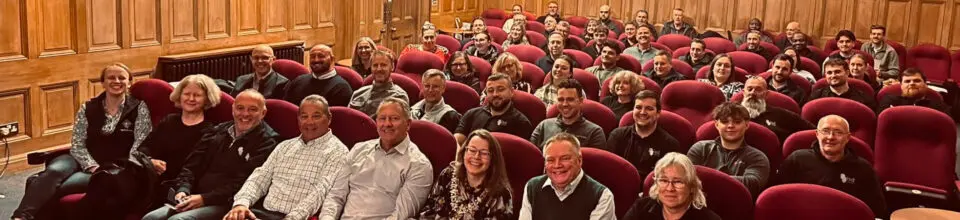
On Tuesday 20 October, The P & M Group welcomed 60 people to Gloucester Guildhall for a screening of the People’s Emergency Briefing, a 50 minute film that sets out plainly what climate change and nature loss mean for life in the UK. Most of the audience were colleagues from across the Group, joined by a local councillor, a representative from the Growth Hub and our waste management partner, Gloucester-based Allstone. After the film, everyone had the chance to ask questions, share their views and talk through what they had seen. We are asking a lot of our people as we push sustainability forward, and it matters that everyone understands why. Giving people the knowledge and insight to make sense of the dual crises of climate change and biodiversity loss is where meaningful action begins.
On 27 November 2025, ten of the UK’s leading experts took to the stage at Central Hall Westminster for the National Emergency Briefing. Their audience was more than 1,200 politicians and leaders from business, culture, faith, sport and the media.
The event was the brainchild of two brothers, Simon and Nick Oldridge. Simon, a former accountant and business consultant turned science communicator, was watching one of the COVID briefings when he asked why the nation had never been briefed on the climate crisis in the same way. He recruited Nick, also a climate science communicator, and with a team of former advertising creative directors they set out to put the UK’s top scientists directly in front of decision makers, without the filter of the media. Their goal was simple: to get the facts back on the table and show what an honest, evidence led national briefing could look like.
The brothers then filmed members of the public reacting to the presentations. The result is the People’s Emergency Briefing, released in April 2026, which features Chris Packham, Jennifer Saunders, leading scientists and a former general. It is designed to be watched together and followed by discussion, which is why it is shown at community and workplace screenings rather than online. Nearly 4,500 screenings have taken place across the UK with another 1500 planned, as part of a growing call for the Government to hold a televised emergency briefing of its own.
Why we chose to screen it
We first came across the film at edie 2026, where the opening presentation was given by Professor Mike Berners-Lee, one of the experts behind the National Emergency Briefing. It made a lasting impression on us. When we looked for a screening in Gloucester, we could not find a single one, so we decided to host our own.
We are committed to managing our own impacts, but we also want to create a ripple effect beyond the business, among our people, in our sector and in our local community. Bringing colleagues, local decision makers and partners into the same room to hear the same evidence felt like the right place to start.
What the film covers
During the film, each expert has around ten minutes to set out the facts in their field. Together they explain what climate and nature breakdown means for the systems we all rely on: our health, our food supply, our national security and our economy. They put it in the context of the UK, looking at the risks we already face and the timescales ahead if we continue as we are.
What makes it powerful is the human element. Alongside the science, we see ordinary people reacting to the evidence in real time, and the experts themselves talking honestly about how the facts make them feel. Crucially, every presentation ends on what can be done, starting now.
What our people told us
We asked attendees to complete a short survey before and after the film, and the shift in their answers was striking. 42 people responded beforehand and 30 afterwards.
| Survey responses | Before the film | After the film |
| Believe that climate change and nature loss will cause significant or severe problems for their life in the next 10 years | 59% | 89% |
| Believe climate change and nature loss are already disrupting their life | 26% | 53% |
| Rate their understanding of the crisis as good or very good | 45% | 83% |
| Believe an emergency level response is needed from the UK Government, similar to COVID or World War II | 28% | 67% |
We asked about seven areas of everyday life: jobs and the economy, food prices, energy bills, national security, transport, house insurance, and health and the NHS. Before the film, 9% of answers said climate change would affect these areas only a little or not at all. Afterwards, that figure was zero.
Every respondent said they felt more informed after the film, 93% felt more motivated to act, and 29 out of 30 said it is very or extremely important for businesses and their employees to act.
The written comments told the same story:
“Very insightful and showed a lot of the positive solutions possible that I was less informed on up until now.”
“It was very informative, a little scary but also a little hopeful. It’s shed light on things we wouldn’t usually think about in our day to day lives because it’s not something that’s widely publicised by mainstream media or the government.”
“I feel angry that it isn’t being taken more seriously by governments, and the public needs to push for action. The more positive points at the end were welcome and reduced the feeling of doom slightly.”
The film does not hold back, and many people left feeling worried, frustrated or angry. Some told us they felt overwhelmed or questioned whether individual action can make a difference without greater intervention from government. Those are honest reactions, and they deserve to be heard.
However, the message of the film is not one of despair. The experts were clear that solutions already exist, and humanity has the knowledge and the tools to act on them. Six in ten of our respondents left feeling more hopeful, and many came away with a clear idea of what they will do differently, from cutting food waste at home to switching to an electric car or solar panels. As one colleague put it:
“Sadly, we all walk past litter and think that someone else will pick it up. Truth is no one picks it up. Going forward I will be that person. We all need to do it rather than wait for someone else to.”
That is the heart of it. Responding to this crisis is the responsibility of everyone, and that includes businesses. Every organisation can look honestly at its own impacts, take action to reduce them, and use its voice to call for the wider change we need.
Project Acorn and what comes next
That is exactly what Project Acorn, our group wide sustainability programme, sets out to do. We are measuring and reducing our greenhouse gas emissions, working with our supply chain, cutting waste, and building social value in the communities where we work. As a business in construction, one of the biggest contributors to carbon emissions, we know we have a significant role to play.
The screening demonstrated to us how much appetite there is across the Group to get involved. People told us they want practical guidance on what they can do, and to see the business leading by example. We will use that feedback to shape our next steps, so that everyone can see how their own actions connect to our wider goals.
We will share more on our progress in our latest sustainability report, which will be published soon. It will set out where we are today, what we have achieved so far, and where we are heading next.
If you haven’t seen the People’s Emergency Briefing yet, we would urge you to find a screening near you. For those of you thinking about hosting one in your own workplace or community, the National Emergency Briefing team provides free guidance to help you do it. Find out more at nebriefing.org or browse the screening map.
« back to PLG News